Remember, remember, the fifth of November...
...gunpowder, treason and plot.
I see no reason
Why gunpowder treason
Should ever be forgot.
(Traditional verse)
Bonfire Night, or Fireworks Night, or Guy Fawkes Night... whatever you call it, it is marked on 5 November each year to commemorate the anniversary of the Gunpowder Plot. In 1605, a group of dissident Catholics tried - and failed - to blow up the Houses of Parliament and King James I. Their plot was discovered in the early hours of 5 November after a mysterious letter was sent to Parliament. The conspirators were tried, found guilty and hung, drawn and quartered.
At the time, Londoners lit bonfires celebrating the fact that James I had survived, and in 1606 the Observance of 5th November Act was passed, enforcing an annual public day of thanksgiving known as Gunpowder Treason Day. Over the following decades, celebrations incorporated effigies of the Pope - maintaining the anti-Catholic sentiment - and often featured fireworks and mini explosives.
Towards the end of the eighteenth century, it became popular for children to walk the streets with homemade effigies of Guy Fawkes, asking for a 'penny for the Guy'. This took the focus away from the Pope and onto Guy Fawkes, and the day began to be known as Guy Fawkes Day. In 1859, the Observance of 5th November Act was repealed. These days, the event has largely lost its religious and political undertones and has become an excuse to build bonfires and attend fireworks displays.
When I was a child, my parents used to host Bonfire Night parties (yes, as well as the Halloween parties) with fireworks and food. My dad built a bonfire in the garden and our neighbours would make a Guy to put on top. One year, one of our chairs had broken a few weeks before so we put it on top of the bonfire and sat Guy atop it. We didn't go around asking for a 'penny for the Guy' - I only came across this tradition in books, such as Enid Blyton's Secret Seven series.
Unlike Halloween - and possibly because it is in competition with it - Bonfire Night seems to be declining in popularity. Fireworks are unpopular owing to to their impact on pets (and many people). Parties at home, such as the ones my family used to have, are rarer. Understandably, it's no longer considered a good thing to provoke anti-Catholic (or anti-religious) sentiment.
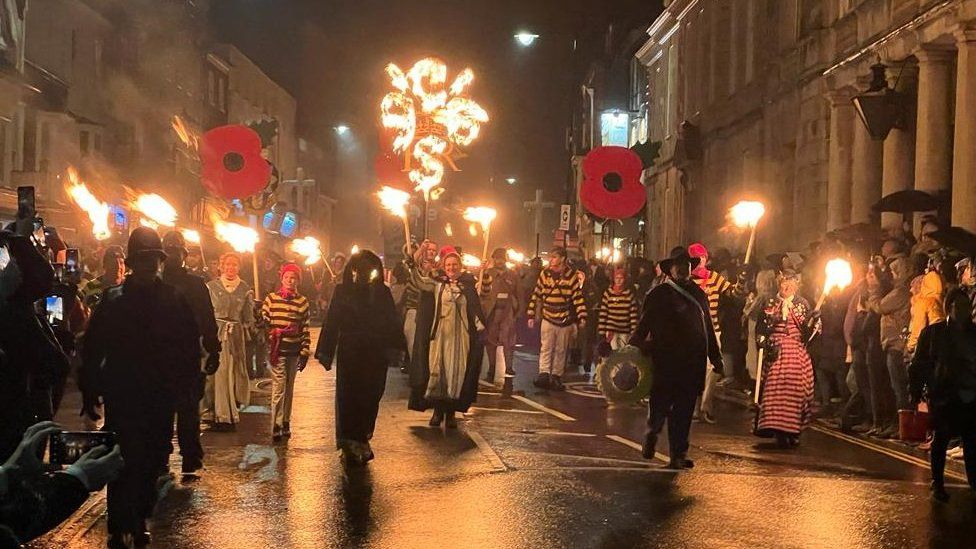
An exception is the annual Bonfire Night celebration in Lewes, Sussex. No fewer than six separate events, each with its own traditions, trademarks and parade, take place on the night. These events are ticketed and become more and more popular every year. Lewes is unusual in that its celebrations commemorate not only the Gunpowder Plot, but the seventeen martyrs burnt at the stake in the town during the period of 1555-57 - hence the seventeen burning crosses paraded through the town. Notoriously, representations of real-life figures are burned at Lewes instead of the traditional 'guy' - past effigies have included Boris Johnson and Vladimir Putin.
Perhaps the future of Bonfire Night lies with larger events such as those in Lewes, with a modern twist as well as links to the past.


Comments
Post a Comment