A maypole, a horse and a walking shrubbery - it's May Day in the UK
As spring finally begins to make itself felt in the UK, a number of celebrations are called into being. One of the earliest - after Easter - is May Day. While officially, May Day is the first day of May, the first Monday in May is taken for the May Day Bank Holiday.
Britain is by no means unique in celebrating this day. May celebrations date back to Roman times, when Floralia celebrations were held in aid of Flora, the Roman goddess of flowers. Celts marked the festival of Beltane with singing, dancing and bonfires. In more recent times, the Catholic church has celebrated the Virgin Mary, Queen of May. In 1899, the International Social Congress chose 1 May as a day to honour workers, later marked by Communist Russia.
The May Day celebrations that have taken place in the UK for hundreds of years, and are still practised today, are a mix of pagan and religious traditions. The Maypole is a key element: it symbolises male fertility, and is used for a dance in which participants weave in and out of one another holding ribbons which make an attractive pattern on the pole. In the past, neighbouring villages would compete to see who had the tallest trunk. Sometimes a May Queen is crowned: a girl from the village or town who walks or rides at the front of a procession or parade.
 |
| Morris dancers in Stratford-upon-Avon |
Morris dancers, who traditionally danced around the maypole, are often involved in May Day celebrations. In Stratford-upon-Avon, dancers "dance up the sun" at 5.25am beside the Avon and then dance all around the town. In recent years, there has been something of a revival of interest in dancing and May Day celebrations, with dances taking place as far afield as Padstow and Edinburgh, Minehead and Glastonbury.
For a more unusual celebration, head to Whitstable or Hastings, where the tradition of 'Jack in the Green' has been revived. Jack's origins are shrouded in mystery: some claim he is a survival from pagan tradition, others that he dates back to the sixteenth or seventeenth centuries. Supposedly, he dates from a time when May Day celebrations meant making bigger and more ridiculous garlands that eventually seemed to cover the carrier in greenery. Nowadays, an individual completely covered in foliage (and in Hastings, wearing a floral crown) heads a procession to mark the day. At the end, he is "slain" (foliage removed) to release the spirit of summer.
 |
| Jack in the Green celebrations in Hastings |
On 1 May 2023 I actually attended a Jack in the Green procession, held in Deptford, south east London. There was a lovely atmosphere and the whole thing had a real celebratory feel.
 |
| Jack in the Green procession in Deptford |
If walking foliage isn't your thing, head down to Padstow in Cornwall, where the 'Obby 'Oss festival takes place each May 1st. Beginning at midnight on the 30th of April, townspeople gather outside the Golden Lion Inn to sing the "Night Song". By morning, the town is decorated for May Day with greenery and a maypole. Throughout the day, two separate parades take place, each led by an 'Obby 'Oss. Each horse wears a mask and a cape over a frame, under which they try to catch young maidens. Late in tne evening, the horses meet at the maypole before returning to their respective "stables".
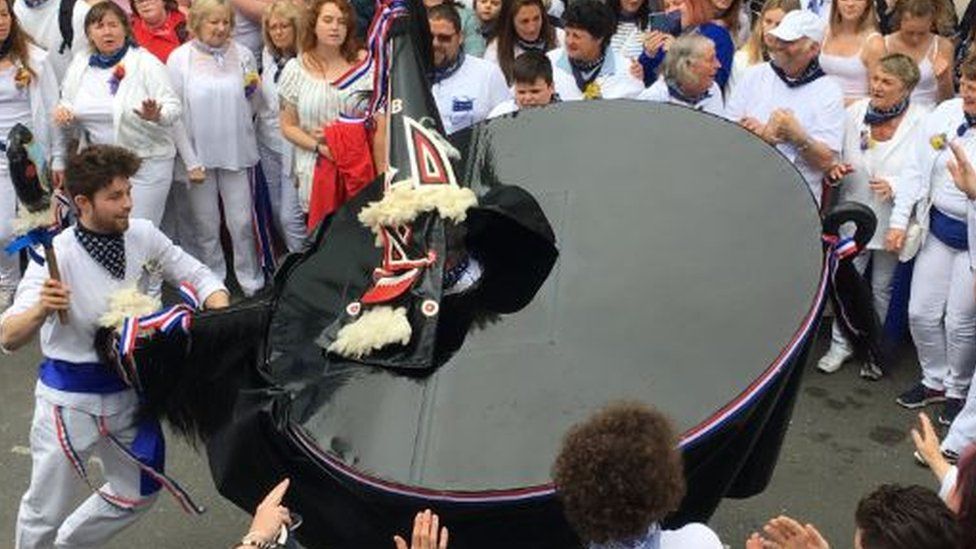 |
| 'Obby 'Oss in Padstow |


Comments
Post a Comment